By Veronica Mihalopoulos
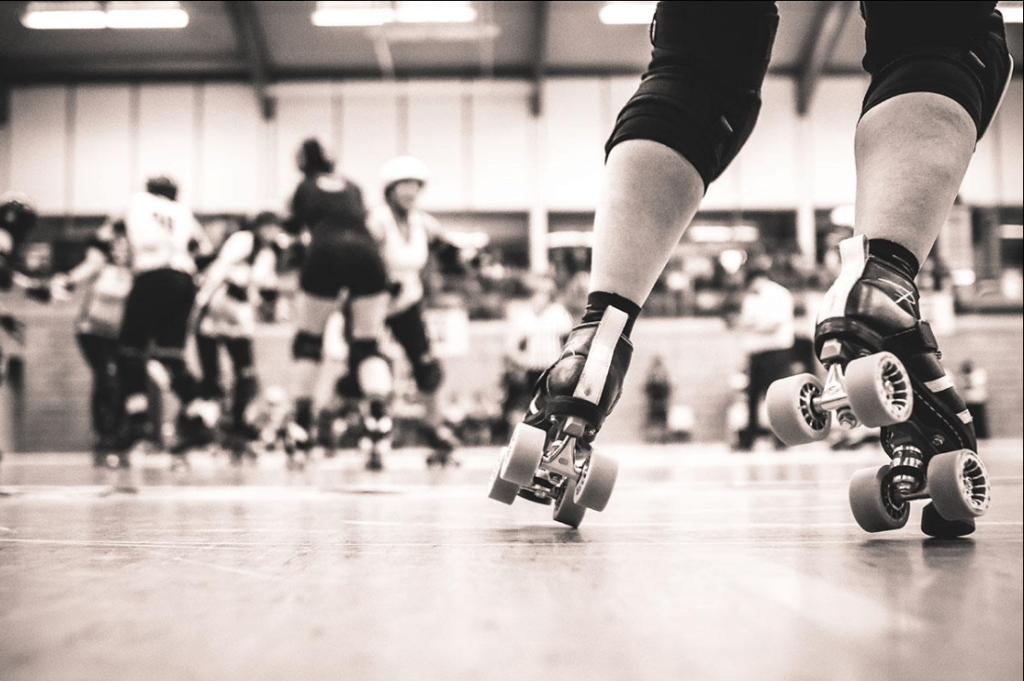
The very first time I saw a roller derby girl, I was vending for Begoths at WonderCon in Long Beach in early 2005. I remember being a little bored, drifting somewhere between daydream and autopilot, when I got up to help a curious but eager customer.
And then she rolled by.
Short black booty shorts that read “Derby Kisses,” striped knee-high socks, black tank… wheels humming on the floor. She handed me a flyer for an upcoming bout and just kept moving.
I remember thinking, what is roller derby???
A couple of years later, I went to see OCRD play and that question got answered real quick. I didn’t just get it… I got hooked.
At the time, I was working on Series 4 Begoths, and something clicked. The names, the personas, the attitude it all lined up. Roller derby names had that same punch as our characters. Big, bold identities with a wink and a bite. But what really hit me?
The women. Strong. Rebellious. Loud in the best way. They felt like a living, breathing version of that riot grrrl energy I grew up loving, skates instead of stage dives, but the same fire.
Roller derby today is wildly inclusive. It’s not just one look, one body type, one background. It’s everyone different shapes, identities, stories all finding their lane and owning it. That’s part of what makes it magnetic.
And yeah… it’s a full-contact sport. Let’s not sugarcoat it.
But it’s controlled chaos. There are rules because nobody’s trying to leave in a stretcher. You can’t hit someone in the back (that’s a Back Block penalty), no targeting the head, neck, or spine, and no cheap shots to the knees. It’s physical, strategic, and fast. You play with heart, not recklessness. You hit with intention, not just force.
Now here’s where the time machine kicks in.
Roller derby’s roots go all the way back to about 1935.
Back then, the world was still shaking off the weight of the Great Depression, and people were hungry for distraction, spectacle, something that felt alive. Enter Leo Seltzer a promoter with a flair for turning motion into theater. He launched what became known as the Transcontinental Roller Derby Race, and it wasn’t full-contact chaos yet. It was endurance.
We’re talking thousands of miles skating on an indoor track. Teams circling for days. Not hours days. It was part sport, part survival test, part live-action story unfolding lap by lap. The audience would come and go, but the skaters kept grinding, chasing distance records like human engines.
And here’s the part that matters this wasn’t just men out there.
From the jump, roller derby was co-ed.
Men and women skating together, competing together, sharing the same track, the same exhaustion, the same spotlight. In a time when most sports kept women on the sidelines or in “separate but smaller” lanes, derby said, nah lace up, you’re in. That alone made it feel a little rebellious in a time when women were very oppressed.
As the sport evolved, especially into the ‘40s and ‘50s, that coed structure stuck. You’d have mixed teams, alternating jams, men’s and women’s matchups woven into the same event. It gave derby this layered energy like two storms rolling through the same sky, back to back.
Then, the sport started leaning toward tcontact. The hits, the drama, the personalities. Derby shifted from endurance to impact, from marathon to controlled collision. But that co-ed DNA? It stayed part of its identity through those early decades.
Modern derby especially under WTFDA (Women’s Flat Track Derby Association) leans more women-focused, building a powerful space centered on female athletes and leadership. But the sport has branched out again with co-ed and men’s leagues, like Men’s Roller Derby Association, and open gender, non binary team members that keep that original “everyone on the track” spirit alive.
So when you talk about derby now being inclusive, it’s not a new coat of paint. At one time it gave women a stage to be something more, outside of the homestead and threw them on skates to compete alongside men. Today roller derby prides itself on inclusivity for every one.
1935 Chicago wasn’t just the birthplace of roller derby.
It was the moment someone looked at a rink and thought,
what if everyone gets to play… and nobody holds back?
I wanted so badly to be part of something real like this.
I remember watching Whip It with the same wide eyed anticipation I had as a kid watching E.T. with my big brother. That feeling… like something magical was just within reach if you were brave enough to grab it.
But I wasn’t.
I didn’t have the guts back then. I was scared of getting hurt, of not being good enough, of stepping into something bigger than I believed I could handle. So I let fear make the decision for me. I let it take that experience off the table before I ever even tried.
And that stayed with me.
Until I turned 40.
Something shifted. Maybe it was time, maybe it was perspective, but I decided I wasn’t going to let that version of myself keep calling the shots. I showed up to a recruitment night for a local roller derby league, nerves and all.
And it ended up being one of the best decisions of my life.
The camaraderie was real. The friendships were real. These weren’t surface level connections, this was a group of people who showed up for each other, on and off the track.
Now, let me be honest, I was no roller derby star. Not even close. I was a total mess on 8 wheels for a while, just trying to find my footing and not eat it on the track. But I practiced. I pushed myself. I passed assessments. (it took a few years)
And I played one game.
One.
And you know what? That was enough.
Because I had made a promise to myself that I would do it, that I would see it through and I kept it. I didn’t need to be an all-star. I just needed to prove to myself that I could show up and follow through.
Not long after, derby paused and life carried me into a different chapter. But I look back on that time with nothing but gratitude. I got to be part of something real, even if just for a moment.
And that “moment” came back around in a way I never expected.
When Cami was first diagnosed, one of my derby teammates happened to work at the same hospital where he was being treated. She rallied the team, and they showed up for us in the most beautiful way sending well wishes, messages of support, and gift cards to help with food while we were in the hospital.
It wasn’t just helpful it was grounding.
In a time that felt isolating and overwhelming, they reminded me that I wasn’t alone.
That’s what roller derby gave me.
Not just a game. Not just a goal I checked off a list.
It gave me a community that showed up when it mattered most.
And that’s something I’ll carry with me forever.
Support your local league!!!